Keep the product story consistent before adapting it per directory.
Step-by-step guide
How to submit my tool without turning launch week into spreadsheet work.
A useful submission campaign starts before the first form. Build one strong product profile, choose directories by fit, adapt the copy, and track every outcome.
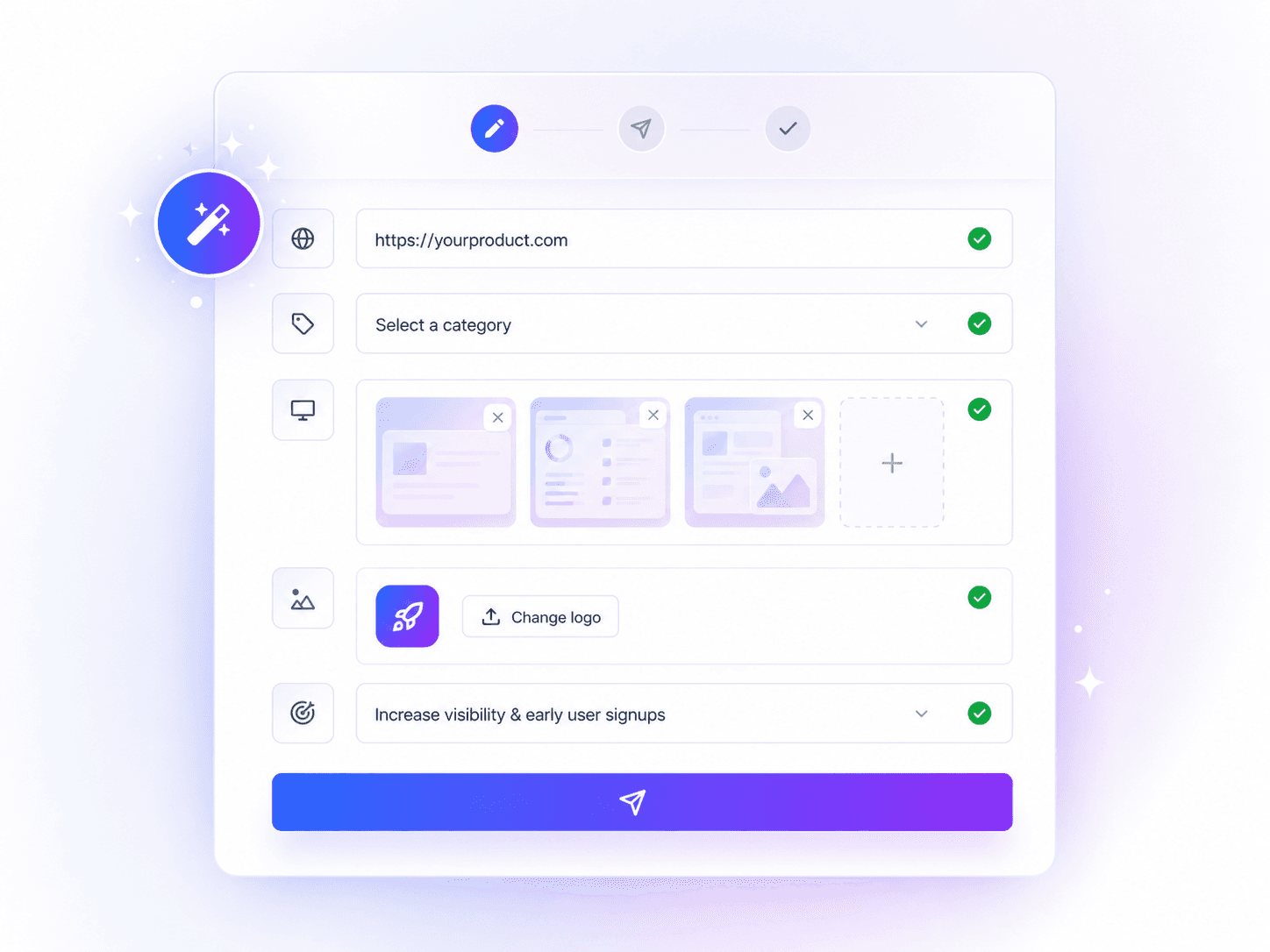
The difference between busywork and distribution is preparation: one clean brief, a filtered target list, and a report you can actually use.
Use categories and quality signals to avoid random submissions.
Manual work is slower than bots but produces cleaner listings.
Step 1
Build the submission kit first
Before you submit anywhere, create one complete product profile. This should include product name, homepage URL, short pitch, long description, target user, category, pricing, logo, screenshots, social links, and founder email.
The kit prevents drift. Without it, every form becomes a fresh writing exercise and your listings start describing the product in inconsistent ways.
Short pitch under 160 characters
Long description with use cases
Screenshots of real workflows
Pricing and contact path
Step 2
Segment directories by intent
A random list creates random results. Group directories by audience: AI, SaaS, developer tools, startup launchpads, free catalogs, paid directories, and niche communities.
Then decide which category angle each directory should receive. A product can be an AI tool in one directory, a productivity app in another, and a developer workflow tool in a third.
Audience fit
Category fit
Link type
Traffic and DR
Editorial quality
Step 3
Submit manually and adapt the copy
Manual submission does not mean pasting the same paragraph everywhere. The better approach is to keep the core positioning stable while adapting fields, category choices, screenshots, and feature emphasis.
Directories with stricter editorial standards usually reward specificity. If a site asks for launch story, do not send pricing copy. If it asks for technical details, do not send founder boilerplate.
Adjust category labels
Respect field limits
Use relevant screenshots
Record account and status notes
Step 4
Track outcomes after launch
The submission is not finished when the form is submitted. Track approvals, live URLs, pending reviews, rejected listings, founder verification emails, and paid upgrade prompts.
This report becomes a useful launch asset: you can monitor referral traffic, update old listings, and reuse the directory set for future launches.
Submitted URL
Live listing URL
Status
Follow-up owner
Notes
How to turn this guide into a usable submission brief
The practical output of a guide should not be vague confidence. It should be a document a founder can hand to someone else without losing context. Write down the product name, homepage URL, target user, core use case, category options, pricing model, screenshots, founder contact, and the proof that makes the product credible.
Then create short, medium, and long versions of the product description. The short version helps with strict directory fields. The medium version works for most submission forms. The long version gives editors enough context when they ask for a founder story, product explanation, or launch background.
This preparation is what keeps quality high at scale. Without it, each submission becomes a rushed writing task and the public listings start to describe different products. With it, the campaign stays consistent while still giving every directory the version that fits its audience.
What to measure after the guide is put into action
Once listings are submitted, track the same outcomes a serious launch team would track: submitted date, account used, category chosen, review status, live listing URL, backlink type, paid upgrade prompts, and founder verification tasks. The report matters because it separates real distribution work from a claim that many forms were filled.
After two to four weeks, review which pages were indexed, which listings sent referral traffic, and which profiles need better screenshots or clearer copy. A directory campaign is not a one-time event if the strongest listings can be updated as the product matures.
Treat the best profiles like small landing pages distributed across the web. They should be accurate, current, and specific enough for a buyer, editor, search engine, or AI assistant to understand what the product does and who it helps.
Ready to build high-quality backlinks?
We'll submit your product to 100+ directories, adapt your listing copy, and return a clear report so you can focus on building instead of filling repetitive forms.
See pricing & get startedPractical checklist
Assets to prepare before submitting anywhere.
A strong directory campaign is mostly preparation. When the source material is clear, each listing can be adapted without inventing positioning from scratch.
What weak submissions look like
- Submitting before the landing page explains the product clearly.
- Using the same generic AI or SaaS description on every directory.
- Ignoring category rules and choosing the closest-looking option.
- Forgetting to track login emails, pending reviews, and live URLs.
What stronger campaigns do instead
- Preparing one reusable profile and adapting it per directory.
- Prioritizing relevant directories before chasing raw backlink count.
- Using screenshots and proof that match each category.
- Maintaining a report that can be audited after the campaign.
Decision support
Common questions before you submit.
Use these answers to decide whether to submit manually, narrow your directory list, or hand the campaign to a managed service.
Done-for-you option
Want the launch list, form work, and report handled?
Send us your product brief once. We prepare the listing kit, submit manually, and return a structured report.